

The Winning Formula
Two full seasons of learning, one major car upgrade and a gutsy strategy call land BMW on the top of the Hypercar podium.

The quotes needed no interpretation.
“Clearly, we were hoping for better than that,” said BMW M Team WRT Principal Vincent Vosse.
“We’re still far away, and that’s not ideal, especially when you look at the package we have here this weekend,” added Dries Vanthoor, driver of the No. 15 BMW M Hybrid V8. “We should be much closer.”
The two Team WRT Hypercars had just qualified 10th and 11th at Spa. They were out-run by one Ferrari—no surprise there—but also both Peugeots, Cadillacs, Alpines, and Aston Martins.
After posting respectable fifth- and seventh-place finishes in the WEC season opener at Imola, BMW was tracking backwards in year three of its WEC journey. And it was happening on the heels of a major revamp of the M Hybrid V8 driven primarily by lessons learned--and motivation to win--in the WEC.
For Team WRT, which added the IMSA GTP program to its duties in the offseason, it was familiar territory. The updated M Hybrid V8’s debut, at IMSA’s Daytona season-opener in January, started out poorly and went downhill from there. Bad practices, worse qualifying.
For race day, they went back to square one.
The No. 24 BMW finished third, putting Robin Frijns, René Rast, Sheldon van der Linde, and Vanthoor on the podium in Team WRT’s IMSA GTP debut. The No. 25 sister car finished eighth.
Strategy shift
At Spa, seeking the BMW M Hybrid V8’s breakthrough WEC win, the team didn’t change the car. It altered its race strategy.
The first hour featured a high-speed parade at the front of the Hypercar field. While some positions were swapped--Kevin Magnussen in the No. 15 BMW jumped from 10th to 6th on the first lap--passing was at a premium.
As the first pit stop window opened, BMW opted to roll the dice with the ninth-place No. 20. Rast followed three other front-runners in, including the No. 12 Cadillac that had led from the start.
While the rest of the field topped up on virtual energy, Team WRT sent Rast out at 60%. With the time savings--he was 16 seconds faster than the No. 12 on pit road--Rast jumped the three cars he followed in. A lap later, the rest of the leaders stopped, and he jumped them, too.
The shuffling left Rast battling Brendon Hartley in the No. 8 Toyota TR010--the only other car on the same strategy. Rast fended Hartley off, protecting the BMW’s clean air in the process.
The veteran German driver then pushed his lead to nine seconds before his second stint ended.
“I was stuck in traffic at first, but the team worked a miracle with its strategy and brought me to the front,” Rast said. “With a clear track, our car just flew.”
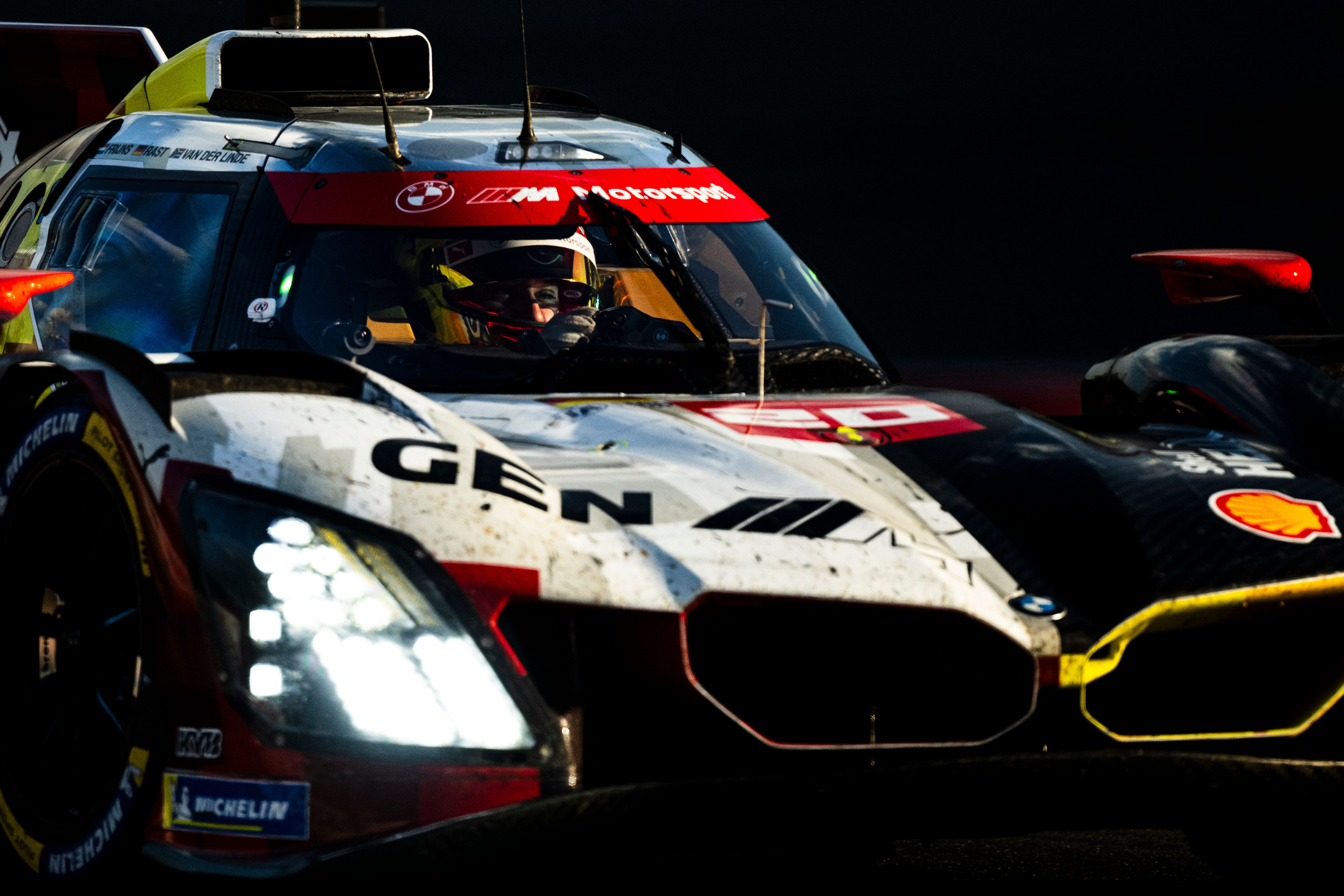
With four and a half hours of racing left, Rast turned the No. 20 over to van der Linde. The No. 20 rejoined the field in 14th, with four new tires and full energy.
Team WRT knew it had the car to run up front. Keeping it there required clean air and some racing luck.
The field stayed green through the next pit stop cycle. Within half an hour, the No. 20 was back up front.
“Our strategy was risky, because if the next yellow phase had come at the wrong time, we would have dropped to the back of the field,” van der Linde said. “But it worked out perfectly.”
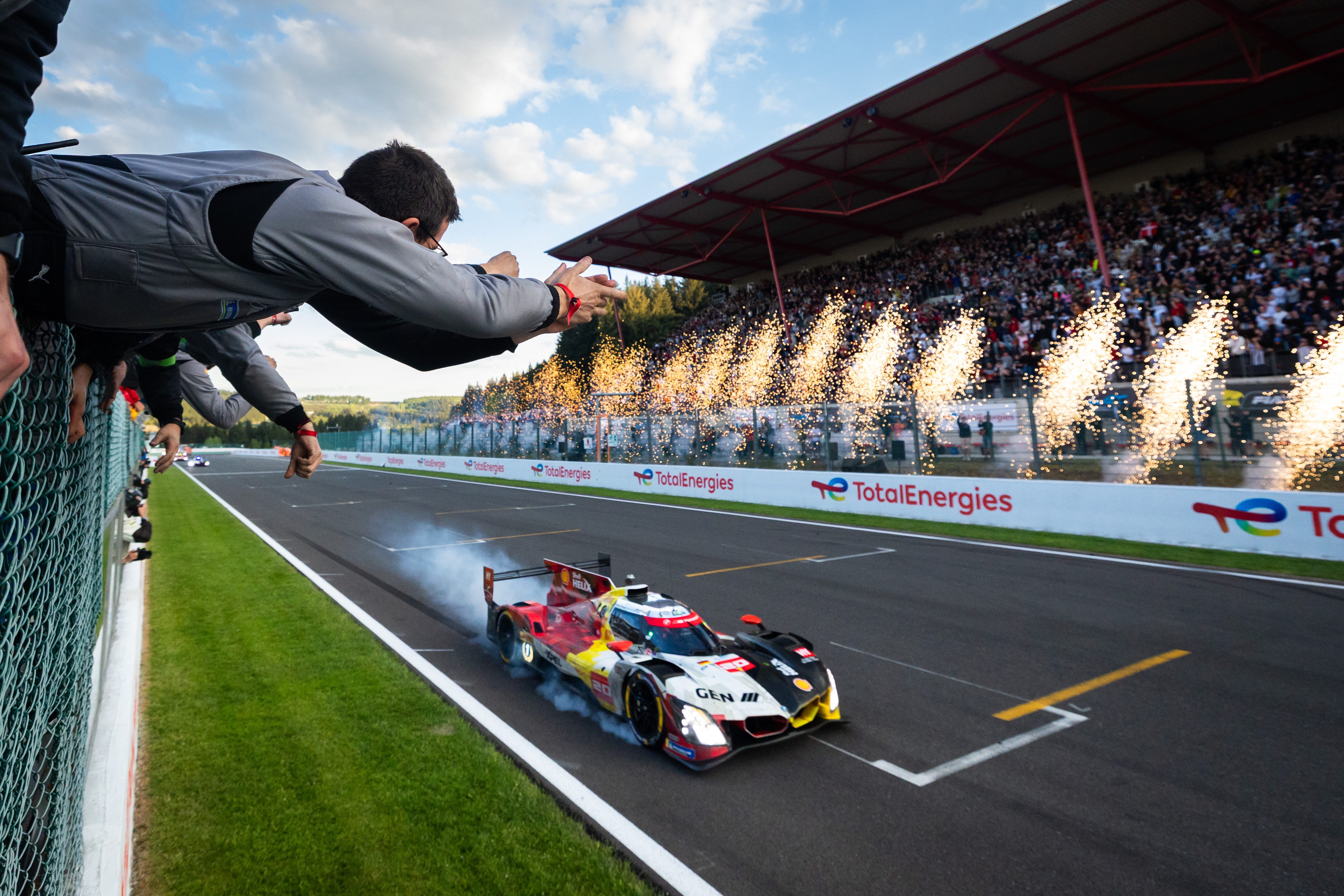
The yellows eventually came, but their timing favored the No. 20’s strategy, and BMW Team WRT notched its first Hypercar-era win.
Meanwhile, the No. 15 team leveraged the M Hybrid V8’s superb efficiency and its own racing luck to make it a 1-2 Team WRT sweep.
While most of the Hypercar field ran 25-lap green flag stints, the BMWs logged 26 laps multiple times.
Fewer stops
With the No. 20 on an alternate strategy, Team WRT let the sister car go until it needed to stop. The No. 15 caught a massive break with two hours to go thanks to a yellow flag period right as its energy was running out.
The blend of strategy and luck meant the No. 15 needed just five pit stops. Each of its full-distance competitors--including the winning sister car--made at least six.
Add in the newly updated BMW M Hybrid V8’s improved consistency, and Team WRT hit on a winning formula.
“With our update for this season, our goal was to make the car more consistent,” said BMW M Motorsport head Andreas Roos. “We achieved that, and that was the key to victory today, because as soon as we had a clear track ahead of us, we were able to set very fast lap times and pull away.”
BMW finished fifth overall in each of its first two Hypercar seasons.
The Spa showing put BMW atop the WEC manufacturers’ standings after two rounds—its best start in the Hypercar era. But not by much--last year it stood second after Round 2.
“We still need to work hard, but we’re progressing well, especially in the race,” said Vanthoor.
“The drivers did a perfect job, and the team was fantastic with the right strategy calls at the right time,” added Vosse. “Next up is the big highlight at Le Mans. We couldn’t go there with a better feeling.”
From the archives
Aerodynamic Advances

Inside BMW’s process to improve its M Hybrid V8s ahead of the 2026 IMSA and WEC seasons.
Gone Too Fast

Isotta Fraschini's FIA WEC Hypercar story has ended, at least for now. It wrapped up a few chapters too soon.
Was an amazing recovery in a race where I thought one car on the podium would have been a good result.